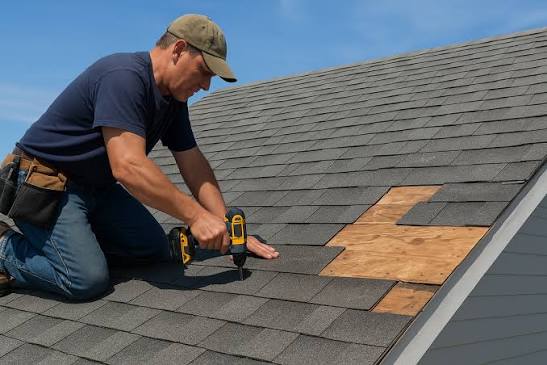
A roof leak shows up as a water stain on the ceiling, a damp patch in the corner of a bedroom, or a drip that starts during heavy rain and disappears once the sun comes back out. What it does not tell you is whether the roof needs a targeted repair or a full replacement. A qualified leak repair roofer can help determine the extent of the damage and identify the most appropriate solution. Those are two very different scopes of work, and choosing the wrong one costs money in both directions: a repair on a structurally failed roof buys you a year before the same problem returns, and a replacement on a roof with five to eight serviceable years left is a spend that did not need to happen yet.
This article walks through the factors a licensed roofing contractor evaluates when a homeowner calls about a leak, and how those factors point toward one answer or the other.
What a Roof Leak Actually Tells You (and What It Does Not)
A leak is a symptom. The entry point, the cause, and the condition of the surrounding materials are the actual diagnosis. Water that enters at a single failure point, such as a cracked pipe boot, a pulled flashing collar at a chimney, or one lifted shingle at a valley, tells a different story than water that enters at several points across the same roof after a single storm.
Single-source leaks on roofs with intact surrounding shingles, adequate granule coverage, and no widespread brittleness almost always call for a repair. The failed component is replaced, the surrounding area is inspected, and the system is restored to working condition.
Multi-source leaks, or leaks that cannot be traced to a single identifiable failure point, suggest a system in general decline. At that stage, repairing individual sections is a process of patching one failure while the rest of the roof continues to age toward the next one.
The Four Factors Contractors Weigh Before Recommending Repair or Replacement
- Roof age relative to material lifespan
Asphalt shingles installed under standard residential conditions carry a functional lifespan of 20 to 30 years depending on the product grade, ventilation quality, and climate. A leak on a 10-year-old roof with no other signs of distress is a repair candidate. A leak on a 24-year-old roof where the shingles show widespread granule loss, curling at the edges, or cracking across multiple exposures is a replacement candidate, because the material has exhausted most of its rated service life.
The repair-or-replace threshold sits roughly at the 70 to 80 percent mark of a material’s rated lifespan. At that point, the cost of repeated repairs over the remaining years often approaches or exceeds a replacement done once.
- Scope and distribution of damage
Damage concentrated in one area, such as a 4-by-6-foot section around a failed skylight curb, is repairable without touching the rest of the roof. Damage spread across multiple slopes, multiple penetrations, or both sides of a ridge indicates a broader failure pattern. Contractors document the damage distribution during inspection because it directly determines whether a targeted repair will hold or whether the same homeowner will call again in 18 months.
- Decking and structural condition
A roof leak that has been active for more than a few weeks begins to affect the materials beneath the shingles. Roof decking (the plywood or OSB panels that sheathing and shingles attach to) absorbs moisture, softens, and in persistent cases develops rot and mold. When a contractor finds soft decking during inspection, the scope of work expands regardless of what the shingle layer shows from the ground. Soft or rotted decking must be replaced before new shingles are installed; that added material and labor cost changes the repair vs. replacement math.
- The cost comparison over a 5-year window
A single repair on a younger roof is straightforward to evaluate: scope the repair, price it, and compare it to doing nothing. On an older roof or a roof with multiple developing failure points, the more useful comparison is what the homeowner is likely to spend on repairs over the next five years versus what a replacement costs today.
A contractor who is honest about this calculation will flag when the repair route is likely to cost more in aggregate, even if the single repair today is less expensive than a replacement. That conversation protects the homeowner from spending money twice.
Signs That Point Strongly Toward Replacement
Certain conditions, when found during inspection, make a repair recommendation difficult to support:
- Shingles are curling, cupping, or cracking across more than one roof slope
- Granule loss is heavy and widespread, with bare mat visible in multiple areas
- The roof has already been repaired two or more times in the past three years for different failure points
- Multiple penetrations (skylights, vents, chimneys, pipes) are failing simultaneously
- The decking shows soft spots in more than one location
- The existing roof carries a second layer of shingles (many jurisdictions cap residential roofs at two layers; a second layer also traps heat and accelerates shingle degradation)
Any one of these conditions warrants a close look at replacement. Two or more together generally settle the question.
Signs That Support a Repair
Repair is the right answer when the inspection finds:
- A single, clearly identifiable failure point with intact surrounding materials
- Shingles in good condition across the rest of the roof (adequate granule coverage, no widespread curling or cracking)
- Dry, solid decking in the affected area and across the adjacent sections
- A roof that is less than 15 years old with no prior repair history for different issues
- Storm damage limited to a defined area rather than distributed across multiple slopes
In these cases, a targeted repair restores the system without replacing what still has years of service left in it.
The Inspection Is the Answer
The decision between roof leak repair and replacement cannot be made from the ground, from a photograph, or from a description of symptoms alone. It is made after a contractor inspects the attic from the inside, examines the roof surface from the outside, and documents the age, material condition, damage scope, and decking health of the system.
A written inspection report with photographs gives a homeowner the information to evaluate the recommendation and make a decision based on the actual condition of their roof, not on a quote they received over the phone.
Ultimately, making informed roofing decisions starts with understanding the condition of the roof and choosing solutions that support the property’s long-term protection. For homeowners and businesses across Nebraska, Apple Roofing provides professional residential and commercial roofing services, including roof inspections, repairs, and replacements. Through its experienced team, Apple Roofing helps property owners address roofing concerns and maintain dependable roofing systems.
View Your Local Roofing Contractor in Kearney, NE in a full screen map
Media Contact:
Company Name: Apple Roofing
Phone: (308) 920-5192
Address: 1312 2nd Ave
City: Kearney
State: NE
ZIP Code: 68847
Country: United States
Website: https://appleroof.com/kearney-ne/
Social Media:
https://www.facebook.com/appleroofing
https://www.linkedin.com/company/apple-roofing-llc/
https://www.youtube.com/channel/UCMNRXjzM6GKfNh7hX8rRRfQ
https://www.instagram.com/appleroofing/